# Use the club calendar
Read the day at a glance, manage sessions and work with floor plans.
Source: https://docs.champagne.dev-ukab.fr/en/guide/staff/planning
**Club calendar** is the calendar of the [reservation categories](/en/guide#reservation-category) you work in, such as group
classes, private lessons or pool loungers. It lets you see who is booked, follow the
places left in each session, mark attendance, manage a session and find a free spot on a
floor plan.
Your administrator chooses which categories appear here.
## 1. Read the week or the day [#1-read-the-week-or-the-day]
Open **Club calendar** in the left menu and select a category in the strip at the top.
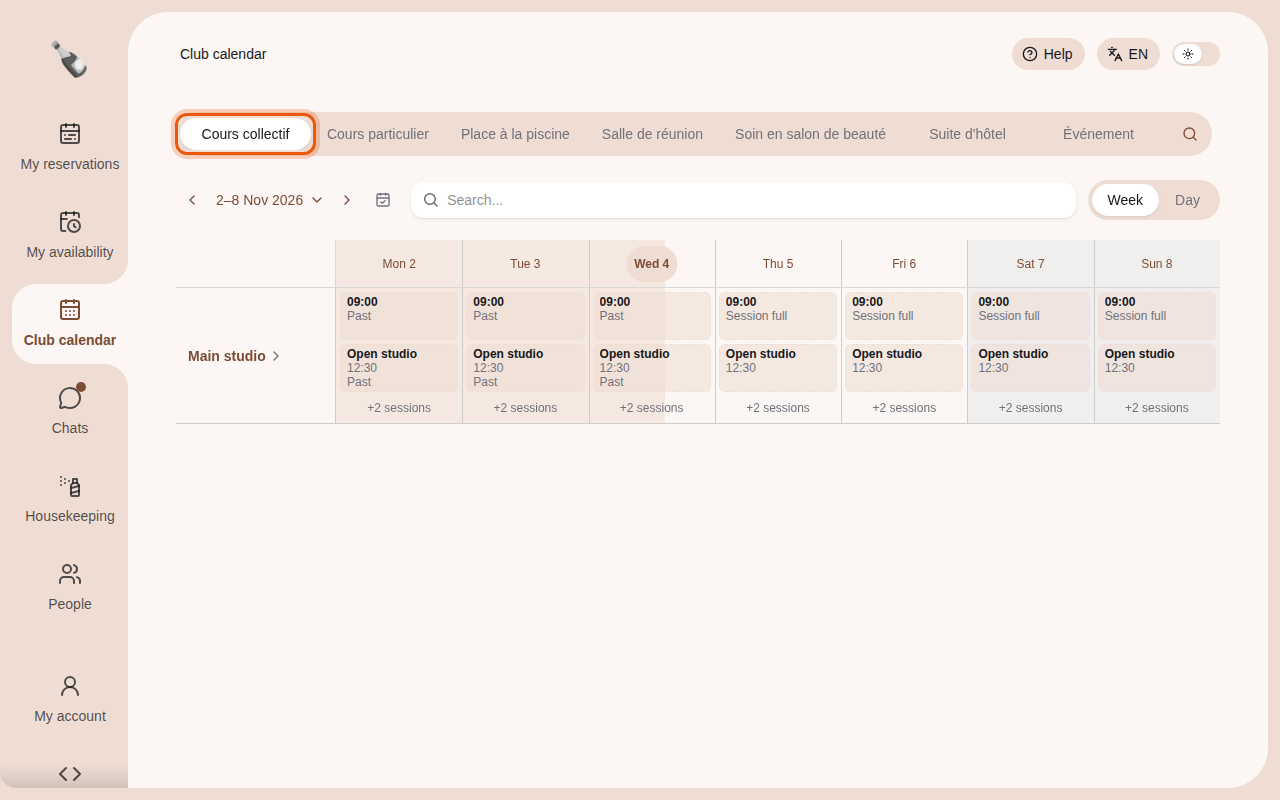
A week of the example group classes Cours collectif in the Main studio, with the daily Open
studio. The control to use is outlined in orange.
* **Week** shows seven days side by side. **Day** shows the hours of a single day.
Select a day name in the header to open that day.
* The arrows move to the previous or next period, and the calendar icon brings you
back to today.
* **Search...** finds a booking by name.
* In group classes, each block is a session. It shows its start time and **Session
full**, the number of places left, or **Past** once it is over. A session with its own
name, such as **Open studio**, shows that name. In **Week**, each day shows its first two
sessions as cards. When a day has more, select a link such as **+2 sessions** to open that day
and see them all.
Bookings work like in the **Reservations** section: select one to open it, or hover over a
free time and select **+** to add one if your [role](/en/guide#role) allows it. See [Handle
reservations](/en/guide/staff/reservations).
## 2. Follow a session and mark attendance [#2-follow-a-session-and-mark-attendance]
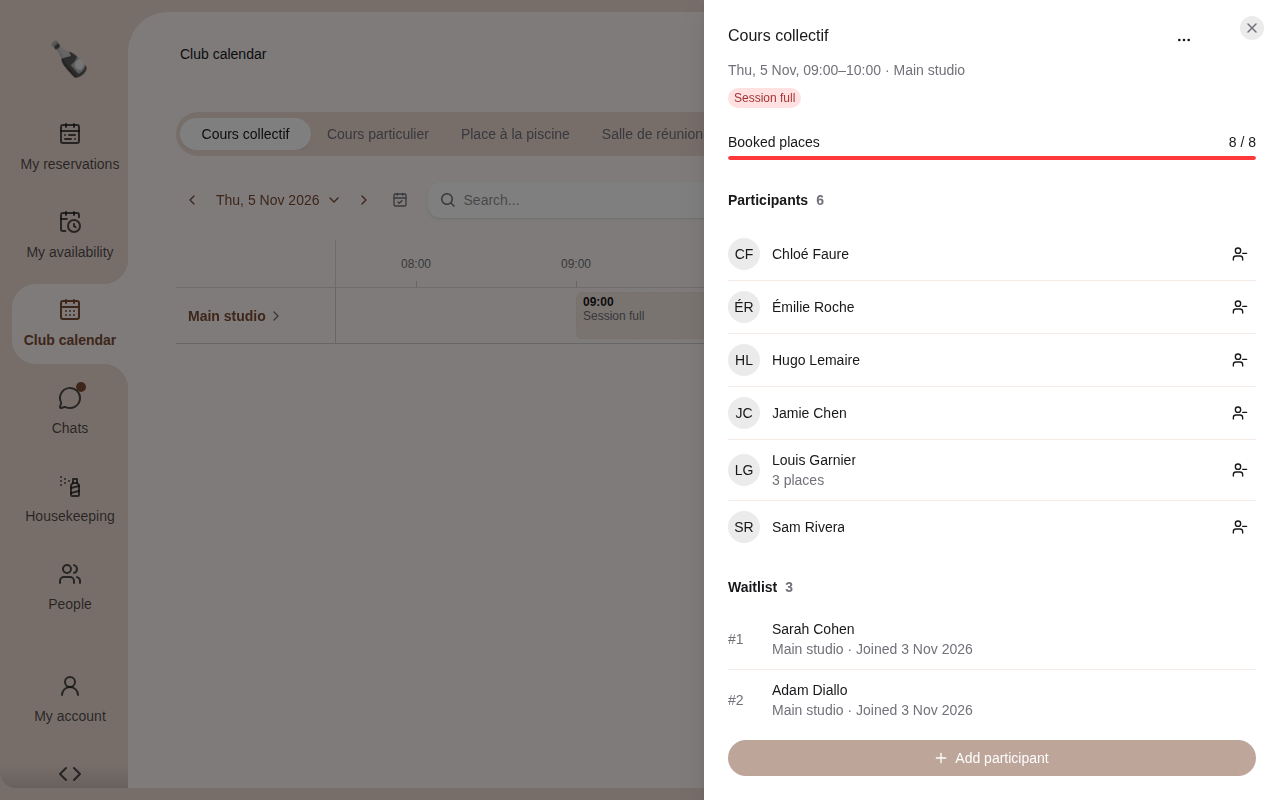
Select a session to open its panel. **Booked places** shows how full it is when the
session has a limit, and **Participants** lists who is coming and how many places each
person booked.
The example 9:00 Cours collectif, full with six participants and three members waiting.
* From the day of the session, mark each participant **Present**, **Late** or **Absent**.
**Late** and **Absent** open once the session starts. **Mark remaining present** marks
everyone you have not marked yet in one go.
* **Add participant** books a member into the session while places remain, until the
session starts. It needs the **Create and change reservations** permission, and marking
attendance needs **Validate attendance and tickets**.
* The icon at the end of a participant's line removes them from the session. Their
reservation is canceled and any payment is refunded, so a confirmation window asks
first. This icon needs the **Create and change reservations** permission. When the cancellation deadline has passed, the window offers **Refund the
price**: leave it unticked to keep the price and return only the deposit.
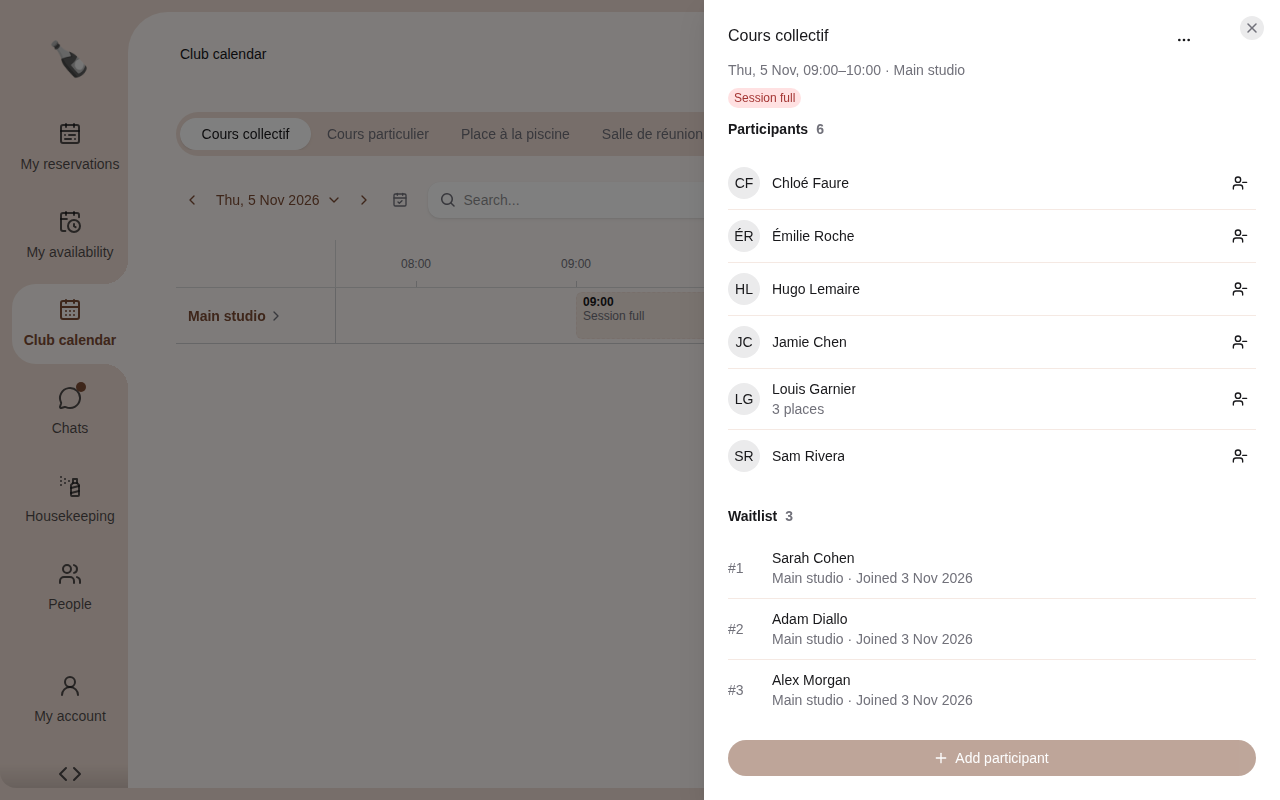
* When members are waiting for a place, **Waitlist** lists them in order, with the date
they joined. A place that frees up goes to them automatically, in that order.
Three members waiting for a place in the example full session.
Labels under the session's title show **In progress** or **Past**, **Session full**, and
**Open access** for sessions people attend without booking, such as the example **Open
studio**. Open access sessions have no **Booked places** meter and no participant list.
> When members get a QR code ticket for the category, **Tickets** above the calendar checks it, and
> **Mark present** records their arrival. See [Check guests in and
> out](/en/guide/staff/check-in-and-deposits).
## 3. Change, export or cancel a session [#3-change-export-or-cancel-a-session]
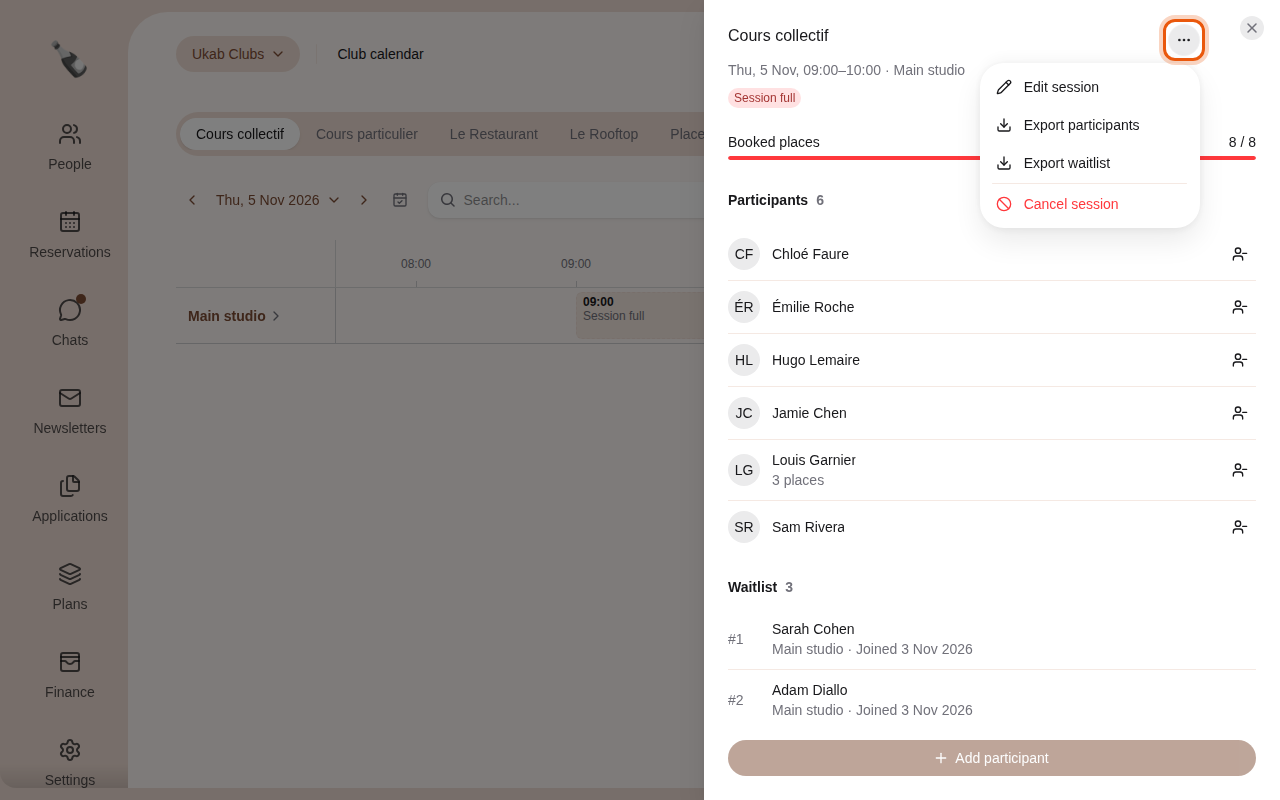
Select the **⋯** button next to the session's title to open **Session actions**. The
choices depend on the session and on your role.
The actions of the example full Cours collectif session, seen by an administrator.
* **Edit session** changes the session's details, such as its time, **Location** or
**Member limit (optional)**. It appears before the session starts, for staff who manage the category. See
[Sessions, guest lists and blocked periods](/en/guide/admins/sessions-and-blocked-periods).
* **Export participants**, when the session has participants, downloads a spreadsheet file (CSV) with each participant, their
reservation status, attendance and number of places.
* **Export waitlist**, when people are waiting for a place, downloads them as a CSV file
too.
* **Cancel session** cancels it for everyone before it starts. It needs the **Create and
change reservations** permission. A window asks **Cancel this session?**:
members are notified and paid reservations are refunded. Select **Cancel session** to
confirm, or **Keep session** to leave it.
## 4. Use the floor plan [#4-use-the-floor-plan]
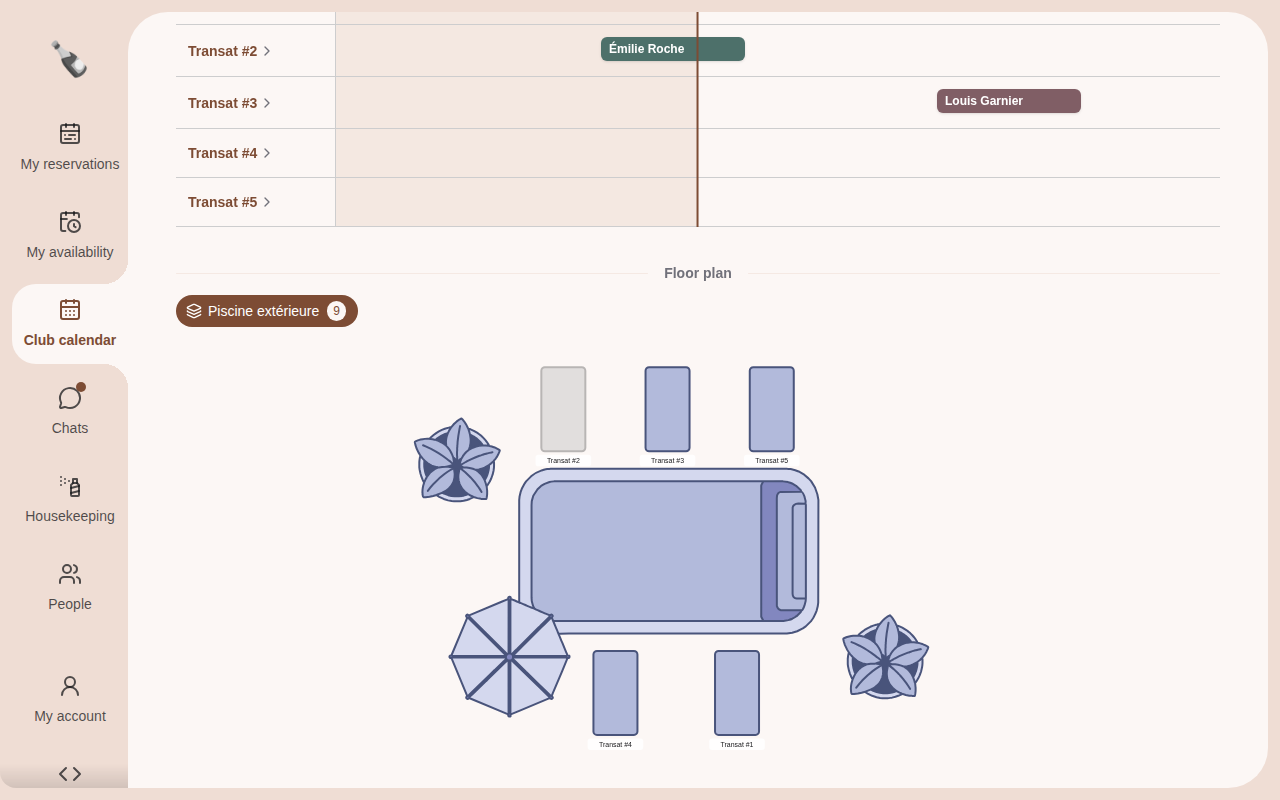
Some categories, such as pool loungers, have a floor plan. It appears under the calendar,
below **Floor plan**. When a category has several plans, select a plan's name above the
drawing to switch.
The example outdoor pool plan Piscine extérieure with its five loungers.
The plan shows each place at the time marked by the vertical line in the calendar. Drag
that line to another time to update the plan. Places that are reserved or unavailable
at that time appear grayed out. Select a free place to open the reservation form for
that place and time, if your role allows you to add bookings.
Moving the time cursor over a booking grays out its lounger on the plan.
> Staff who manage the category can select **Edit floor plan** to arrange the layout. The [AI tools
> for your floor plan](/en/ai-flows) guide explains how to [import an existing
> plan](/en/ai-flows/plan-import) and [create new objects](/en/ai-flows/artwork-generation).